

Risa Hugo is a Canadian/Japanese illustrator with a Bachelor of Fine Arts from Emily Carr University of Art and Design. She spent most of her childhood living between Canada and Japan. Risa currently lives on a small farm located in Southern interior of BC with her husband and three sons. I am absolutely delighted that Risa has agreed to have a long-distance conversation with me about our new book Who Needs the Dark? (Owlkids)
Laura: First, let me say how delighted I am with the illustrations in this book. You captured its blend of observation and imagination—noticing details of the world around us but also being aware of our inner worlds and the realm of dreams and wonder. This can’t have been easy to do! When I write I am very aware of the sound and rhythm of the words, but I don’t always think visually. Sometimes I use abstract concepts or ideas without considering how they can be rendered artistically. Were there parts of Who Needs the Dark? that were especially tricky to illustrate?
Risa: Yes! Every project has at least one or two spreads for which I struggle to come up with illustrations. For this book it was the spread with honeybees. Most of the pages I actually didn’t struggle that much with, which felt great because I don’t really enjoy thumbs [thumbnails: the first sketches for the book]. One other example is the spread which starts with, Every night when dark comes… I loved the idea of that paragraph. To me the most important thing I wanted to capture was that last question: Are you still the same you as before? I ended up drawing something vague (a child trying to fit herself back into a bassinet) and I was happy when everyone liked the concept and didn’t tell me I needed to be more specific! It’s one of my favourite illustrations in the book. Editorial Director Jennifer and Art Director Alisa from Owlkids were both amazing!

Laura: How did the subject matter of the book influence your colour palette? How did you bring variety to the many scenes involving darkness?
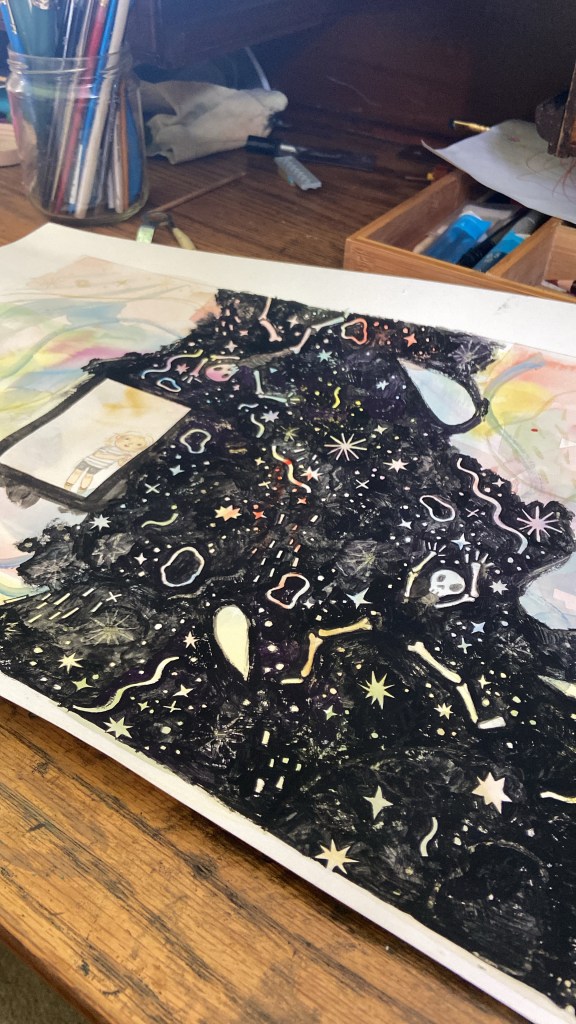
Risa: I’m very intuitive when it comes to picking colour so it’s kind of hard to answer, but my first thought was the book needed to use a lot of black…that’s exciting! However I do remember making a conscious decision to never put black as it is on the paper. Every bit of black has an under-layer of some sort of colour because dark is more like gradient and I thought that was best way to capture that in my illustration.
Laura: How do you feel about the dark? Did this affect how you approached illustrating this book?
I like dark! It’s spooky, comfortable, and beautiful. I have lots of memories associated with dark, like the times when I had to cuddle up to my mother because I was so scared of the dark shadows in the closet. This did affect my approach to the book because I kept leaning more into the fantasy element of the dark, and not the scientific side of it! Now that my son is doing exactly the same thing I used to do when I was little, I was so happy to be part of this book that deconstructs “dark”.
Now it’s Risa’s turn to ask questions…
Risa: When my agent Jacqui came to me with the offer to illustrate this book I said yes immediately because I’ve been wanting to draw something like this for a while. What made you want to write a story about the dark?
My stories often come from my own experiences and memories. One of the memories behind Who Needs the Dark? is the ice storm of 2013 and spending days without power. For some people this brought real hardship, and I don’t mean to downplay that. But in my own family, I noticed that without electricity to power devices and artificially extend the day, we felt less rushed, calmer, and closer to each other. We read aloud, went to bed with the sun, and slept soundly. After that, I found myself thinking a lot about the gifts of darkness—both physical and metaphysical.
The specific catalyst for the story was a bad headache. One afternoon during Advent—a season devoted to anticipating and celebrating the coming of light—I was flaked out on the couch with a towel over my face, thinking that darkness was the most comforting thing in the world. As I lay there, I started composing a poem in my head—a kind of love letter to the dark—expressing all the things that are good about it (starting with the fact that it didn’t hurt my head). That poem was the seed of this story.
As a child, I was scared of the dark. Only gradually did I learn that darkness is as essential to life as light. When darkness is lost from our environment, as happens with light pollution, we all suffer. So there are some environmental concerns underlying the book too, but mostly I want to help young readers get to know the dark and all its beauty and goodness.
Risa: For Who Needs the Dark? The most difficult spread to illustrate was the one with honeybees. I had to find the balance between being informative and fun. Did you also have a section you struggled with?
The biggest struggle for me was not a specific section but finding ways throughout to connect a child’s experience of darkness with similar things from nature.
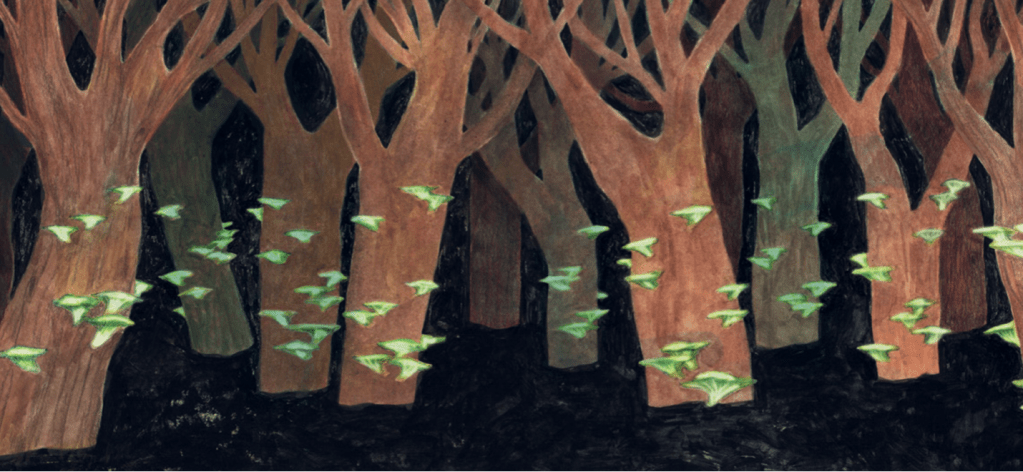
I began by brainstorming the positive role of darkness in human life and the natural world—things that darkness does, or makes possible, or teaches us. I boiled these down to a dozen or so, then started to search for places where human experience echoed similar things in the lives of plants and animals (and fungi). I love the spread about how darkness can be a place to shine. Oyster mushrooms, which are bioluminescent, are paired with children dancing around in glow-in-the-dark outfits! It makes me smile every time I look at it.
Some of these parallels were easier to find than others. For instance, we all need sleep, and it is not hard to imagine other animals dozing—and even dreaming! But what about metamorphosis? Humans change as we grow, but not as radically as butterflies or fireflies. Still, there is something about the idea of becoming someone different that kids can relate to. I love how you (Risa) showed a young child in her old bassinet that she has clearly outgrown, but which still feels like home in some way. I thought that was a very truthful and relatable way of conveying the strangeness of growing up. We are still ourselves—but not!
Obviously, we don’t burrow underground like larva or disappear into cocoons and emerge transformed. But I hope children get the sense that they grow and change too, and that darkness helps them do it.
Risa: Once I make the thumbs (very first sketches for the book) I tend to use those as a reference, and I won’t re-read the text which was the reason why I drew buck (instead of a doe) on page 24-25 even though it clearly said she on your text. I thought it was super nice of you to change your text when you had every right to ask me to fix the illustration. It really felt like a collaboration. Are you always this open with your story?
Yes, I try to be. Picture books are collaborative and that requires mutual respect and flexibility. Although the words come first, that doesn’t mean they have priority over the illustrations. I never want to cling to a story so tightly there is no room for the illustrator to interpret and tell it in their own way.
Every now and then there will be something in the rough sketches that doesn’t match my own vision for the story, and I appreciate being able to tell the editor or art director what I had in mind. But at the same time, I try to be open to something different—maybe being surprised.
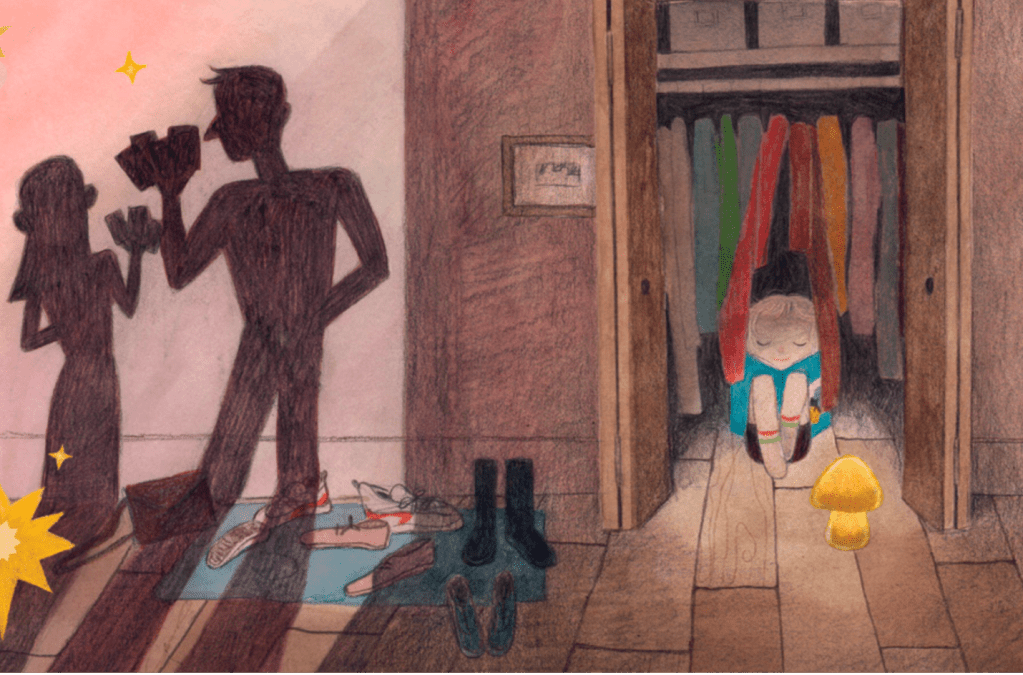
For example, in Who Needs the Dark? there is moment in the text where I talk about being dazzled by too much light. When I wrote it, I was picturing my son in kindergarten, overwhelmed by stage fright at a school assembly. He pulled his paper crown down over his face to block out the spotlight. The actual spread for that page shows a child reading a book in the closet while a grownup house party happens in the background. Although that vision was not the same as mine, the feeling made sense to me—wanting to curl up in the comforting dark. I love how the same words evoked different images in each of us.
As for tiny changes to the text to match the art (as with the stag and doe), I have no problem with that. It seems a shame to ask the illustrator to redo work when shifting a few words around could fix the problem. In my book All the Faces of Me I described the nesting Matryoshka dolls as wearing “frilly aprons” but the illustrator, Salini Perera, decorated them with flowers instead. The dolls looked great the way she drew them, so we changed the words to “frilly flowers” (which added some alliteration).
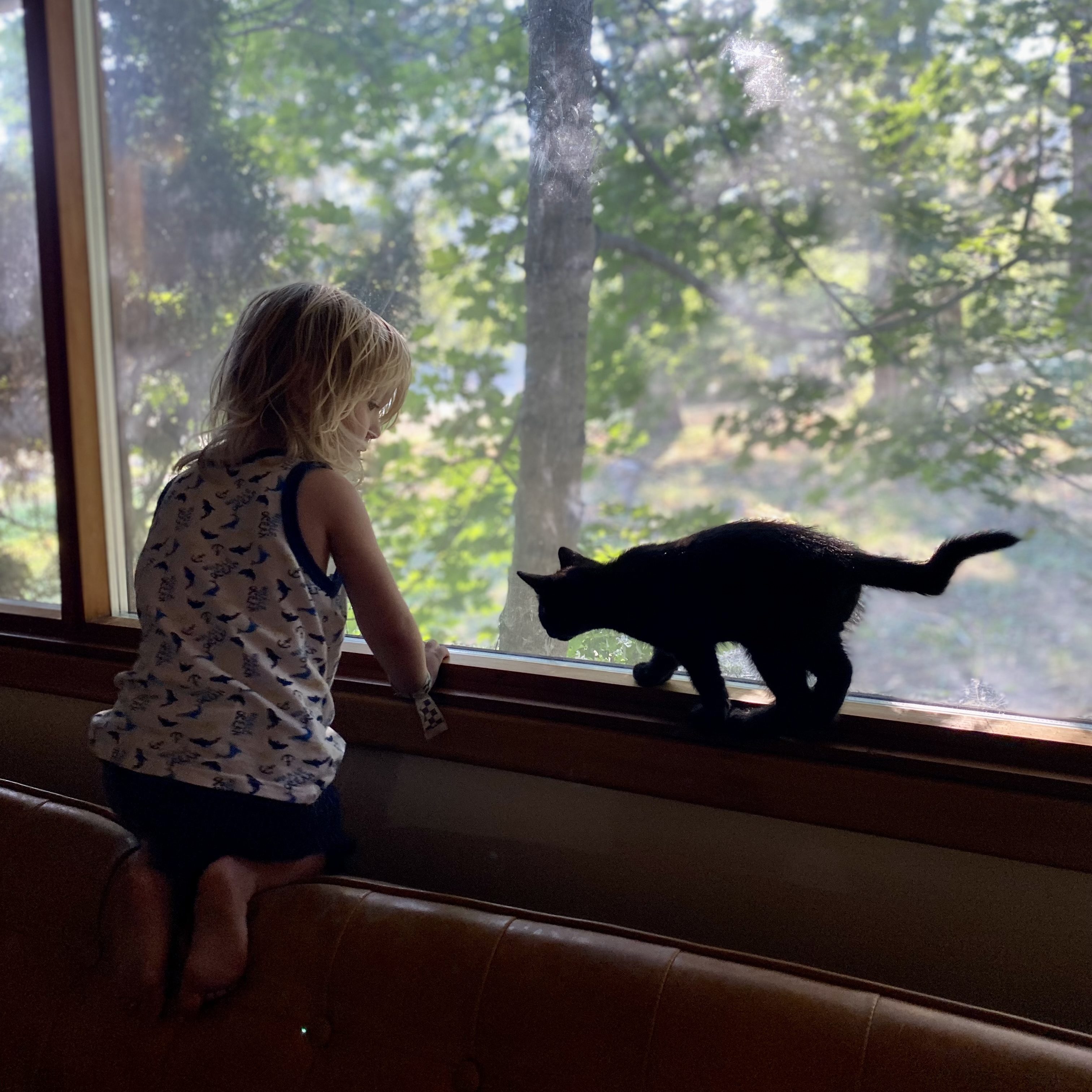
My heartfelt thanks to Risa for taking the time to talk with me and to share some photos, including this adorable one of her son, Milo, to whom Who Needs the Dark? is dedicated, and their cat Takkie, who was the inspiration for the black cat in the book.
Learn more about Risa and her work on her website and follow her on Instagram @risa_hugo
 Laura Alary