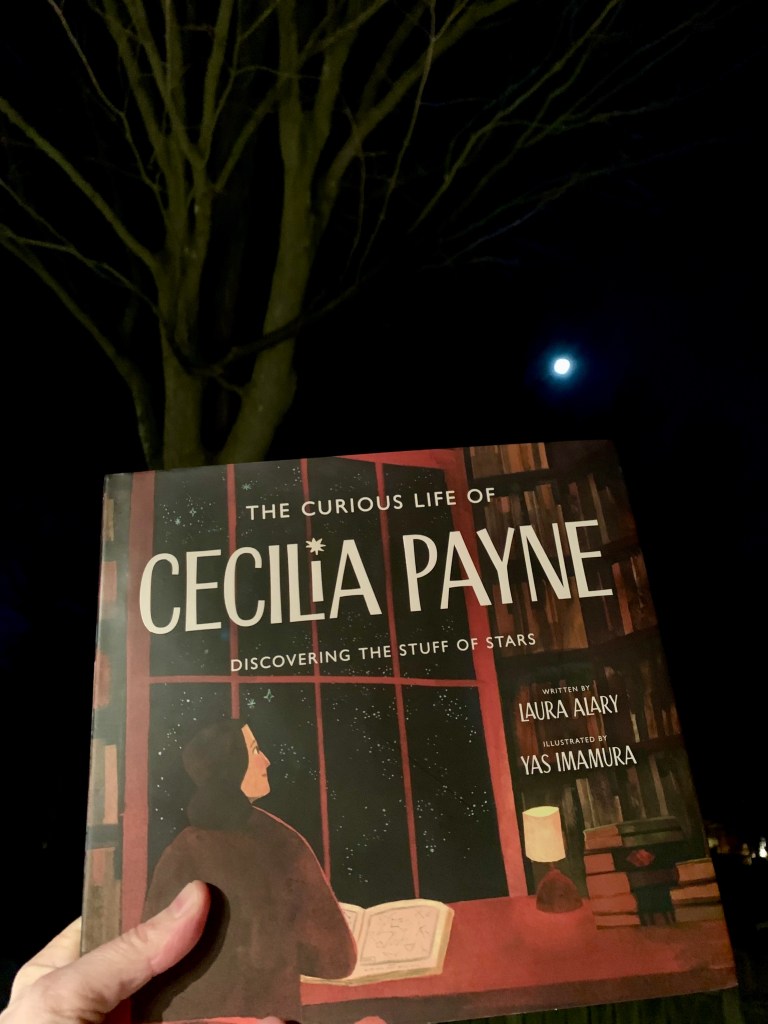
For me the turn of the year tends to be a time of retrospection rather than looking ahead. I like to look back and survey where I’ve come and what I’ve learned. But this year I am also anticipating the arrival of a new book–and soon! The Curious Life of Cecilia Payne: Discovering the Stuff of Stars will be published by Eerdmans Books for Young Readers on January 27th, just in time for the International Day of Women and Girls in Science on February 11th and Women’s History Month in March (in the US, that is; Canada celebrates it in October).
I have written before about my love of biographies (both reading and writing them). I love the mind and heart-expanding effect of looking closely at someone else’s life. What interests me is not simply the achievements and successes of remarkable people, but the struggles, the disappointments, even the failures.
Cecilia Payne was the first PhD graduate in astronomy from Radcliffe College, the first woman to be appointed a full professor at Harvard, and the first person to discover what stars are made of. But she was also once a girl who had trouble fitting in at school, whose brother was given opportunities denied to her, and who–at a critical moment in her career–doubted herself and her findings. These obstacles, and how she made it past them, interest me just as much as her many accomplishments, as you will see if you seek out a copy of my book.
In her recent review for Pine Reads Reveiw, Danielle Hartshorn writes:
“There are so many women whose groundbreaking contributions to the world are unknown to most—whose stories deserve to be told—and Cecilia Payne is one of them. The Curious Life of Cecilia Payne: Discovering the Stuff of Stars is a tribute to a remarkable female trailblazer in astrophysics, and I thoroughly enjoyed reading about Payne’s life. Seeing how inquisitive, analytical, and dedicated she was to learning, despite the obstacles standing in her way, was nothing short of inspiring. Unlike some biographies I’ve read, this book is never impersonal. Payne’s story retains a compelling authenticity, especially when showcasing her surprising vulnerability when she doubts her findings about the stars. The book reminds young readers to trust and believe in themselves while allowing them to identify with Payne.”
So if you’re looking for a book that celebrates women in STEM and the history of science, combined with a strong emphasis on social-emotional learning, The Curious Life of Cecilia Payne may be just what you need.
 Laura Alary